


Some shots from a quick business trip to New England on Friday… we went up with a stop at Baltimore, and came home through Chicago. Colors were spectacular in New Hampshire and Massachusetts, but unfortunately no time to stop and enjoy them. All of these are simple iPhone shots, mostly from moving cars or planes. The burger is a “Holy Cow” burger we enjoyed at Harry Caray’s at Midway Airport in Chicago!
A GENERALLY DRY WEEK: The low level easterly flow continues today, meaning the sky will remain generally cloudy. A little light rain has developed this morning in that moist flow, but a ridge aloft should keep rain from becoming widespread, or really significant. Highs will be in the 70s today.
The sky clears tonight, and the mid-week period looks brighter and warmer, with a good supply of sunshine along with highs in the low 80s tomorrow through Thursday.
LATE WEEK AND THE WEEKEND: A surface front will push through the state at the end of the week, but the 00Z GFS is not very bullish on rain. We might mention just a chance of a shower on Friday, but I think much of the state will remain dry.
A surge of cooler air will push into the state over the weekend… looks like highs in the 70 to 75 degree range, with lows mostly in the 50s Saturday and Sunday. We might see a few upper 40s in the cooler valleys.
THE LAND OF VOODOO: The GFS shows the next good rain event around October 23 thanks to a deep cut-off upper low near Memphis. And, again, I would not be surprised to see a really good push of significantly colder air before the month is over, simply because of the depth of the cold air over Canada.
WEATHER BRAINS: Don’t forget you can listen to our weekly 30 minute netcast anytime on the web, or on iTunes. This is the show all about weather featuring many familiar voices, including our meteorologists here at ABC 33/40. You can even listen here on the blog; look for the player on the top left. We will record a few episode tonight; it will be available by midnight.
STORM ALERT XTREME: Want to be trained as a storm spotter? Want to join the ABC 33/40 Skywatcher team? Our annual training event, Storm Alert Xtreme, is coming up on Saturday November 15 at the BJCC during the annual Birmingham International Auto Show. You will be trained by the best SKYWARN trainer in the nation, our own Brian Peters (he has trained over 6,000 Alabama storm spotters over the years), and learn from one of the most brilliant weather researchers in the country, our own Dr. Tim Coleman. We encourage all of our Skywatchers to attend this every year; you simply cannot get enough training. We will begin at 9:30, and be out by 3:30. And, everyone that attends Storm Alert Xtreme gets free admission to the Alabama International Auto Show. There is no admission charge, and no need to register. Just show up, but get there early for a good seat. We had a packed house last year.
I am speaking at the University of Montevallo this morning…. I will be back in the office by early afternoon, and the next Weather Xtreme video should be posted by 3:30 or so. Enjoy the day!
Buffalo’s earliest lake effect snowstorm on record dumped 8.3 inches of snow on the city on October 12, 2006, setting a new record for the most snow on any October day. The record didn’t last long, as 10.9 inches fell on the 13th, breaking the new record. A total of 22.6 inches fell during the storm, the largest October snowstorm in the city’s history.
With trees still in full leaf, the heavy, wet snow brought down tree limbs and power lines. Ninety percent of the city’s trees suffered damage. The event was nicknamed “Arborgeddon” by local residents. Electricity was out to over 300,000 people.
The event was not forecast in advance. Forecasters knew that there could be a lake effect event as much as a week out. By early afternoon, they were still only forecasting 1-3 inches with some isolated six inch amounts. Since major lake effect events are rare when the lake water is still warm in October, forecasters did not believe a large event could occur. There had only been four events of two or more inches of snow in any October in the weather history of the city.
The lake temperature was 3 degrees above normal. This combined with an extremely cold airmass to setup perfect conditions for an extreme event. A long fetch of the cold air across the warm lake helped. It takes a fetch 50 miles long for a major event. The difference between the water temp and the 850 mb temperature was 75F. Inversions can stifle lake effect lake effect snow events also. Clouds were able to grow to heights of 25,000 feet during Arborgeddon.
A state of emergency was declared in Buffalo the following morning.
000
WTNT34 KNHC 130240
TCPAT4
BULLETIN
TROPICAL STORM NANA ADVISORY NUMBER 2
NWS TPC/NATIONAL HURRICANE CENTER MIAMI FL AL142008
1100 PM EDT SUN OCT 12 2008
…TROPICAL STORM IN EASTERN ATLANTIC EXPECTED TO WEAKEN…
AT 1100 PM EDT…0300Z…THE CENTER OF TROPICAL STORM NANA WAS LOCATED NEAR LATITUDE 16.6 NORTH…LONGITUDE 38.8 WEST OR ABOUT 980 MILES…1580 KM…WEST OF THE CAPE VERDE ISLANDS.
NANA IS MOVING TOWARD THE WEST-NORTHWEST NEAR 8 MPH…13 KM/HR…AND THIS MOTION IS EXPECTED TO CONTINUE FOR THE NEXT DAY OR TWO.
MAXIMUM SUSTAINED WINDS ARE NEAR 40 MPH…65 KM/HR…WITH HIGHER GUSTS. NANA IS EXPECTED TO WEAKEN TO A TROPICAL DEPRESSION ON MONDAY.
TROPICAL STORM FORCE WINDS EXTEND OUTWARD UP TO 85 MILES…140 KM TO THE NORTHEAST AND SOUTHEAST OF THE CENTER.
THE ESTIMATED MINIMUM CENTRAL PRESSURE IS 1006 MB…29.71 INCHES.
REPEATING THE 1100 PM EDT POSITION…16.6 N…38.8 W. MOVEMENT TOWARD…WEST-NORTHWEST NEAR 8 MPH. MAXIMUM SUSTAINED WINDS…40 MPH. MINIMUM CENTRAL PRESSURE…1006 MB.
THE NEXT ADVISORY WILL BE ISSUED BY THE NATIONAL HURRICANE CENTER AT 500 AM EDT.
Folks down in Shelby County are observing a nice rainbow east of I-65 in the Pelham area as the sun drops in the west and showers continue to the east.
Those showers extend from southern Jefferson through Shelby County eastward through Talladega, Clay and Calhoun Counties.
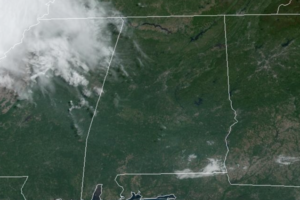
Cloudiness is thickest south of a line from Vernon to Birmingham to Jacksonville, but there are some breaks in the clouds starting to show through. North of this area, skies have become partly cloudy.
Temperatures are still mostly in the 70s. A few spots that have had more sunshine will post readings around 80 before the day is out.
The showers are moving quickly to the northwest. Rainfall amounts will be very light, only amounting a couple of hundredths of an inch.
The disturbance in the Atlantic between Africa and the Lesser Antilles has had a circulation for much of the day, but forecasters were waiting for it to hold onto some convection. The NHC has decided to upgrade it to Tropical Storm Nana.
It is the 14th named storm of the season.
It will move WNW, but probably not survive more than 36 hours as it is in an area of hostile upper level winds.
WTNT34 KNHC 122047
TCPAT4
BULLETIN
TROPICAL STORM NANA ADVISORY NUMBER 1
NWS TPC/NATIONAL HURRICANE CENTER MIAMI FL AL142008
500 PM EDT SUN OCT 12 2008
…NEW TROPICAL STORM FORMS IN THE EASTERN ATLANTIC…
AT 500 PM EDT…2100Z…THE CENTER OF TROPICAL STORM NANA WAS
LOCATED NEAR LATITUDE 16.4 NORTH…LONGITUDE 37.9 WEST OR ABOUT 925
MILES…1485 KM…WEST OF THE CAPE VERDE ISLANDS.
NANA IS MOVING TOWARD THE WEST-NORTHWEST NEAR 7 MPH…11 KM/HR…AND
THIS MOTION IS EXPECTED TO CONTINUE OVER THE NEXT COUPLE OF DAYS.
MAXIMUM SUSTAINED WINDS ARE NEAR 40 MPH…65 KM/HR…WITH HIGHER
GUSTS. WEAKENING IS EXPECTED DURING THE NEXT DAY OR SO…AND NANA
IS FORECAST TO BECOME A TROPICAL DEPRESSION TONIGHT OR MONDAY.
TROPICAL STORM FORCE WINDS EXTEND OUTWARD UP TO 85 MILES…140 KM
FROM THE CENTER.
ESTIMATED MINIMUM CENTRAL PRESSURE IS 1005 MB…29.68 INCHES.
REPEATING THE 500 PM EDT POSITION…16.4 N…37.9 W. MOVEMENT
TOWARD…WEST-NORTHWEST NEAR 7 MPH. MAXIMUM SUSTAINED WINDS…40
MPH. MINIMUM CENTRAL PRESSURE…1005 MB.
THE NEXT ADVISORY WILL BE ISSUED BY THE NATIONAL HURRICANE CENTER AT
1100 PM EDT.
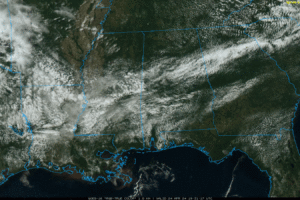
Clouds are thick across most of Central Alabama this morning thanks to a strong easterly flow around the bottom end of a ridge of high pressure that extends along the East Coast.
It is going to become increasingly breezy today, with winds increasing out of the east, averaging about 8-16 mph with gusts over 20 mph at times. The fresh breezes are thanks to the combined effects of the upper ridge building southward and the upper low that has been off the coast of Georgia and the Carolinas moving back to the southwest.
Our upper low is over southeastern Georgia this morning. This system is spreading showers into Central Georgia. Some of these showers may rotate into Alabama later today. Rainfall will be spotty and light. With the strong easterly flow, there could be a little drizzle, especially over eastern sections this morning.
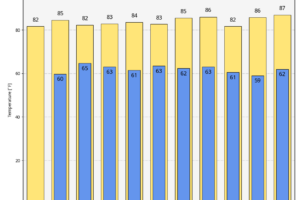
Temperatures are in the 60s to near 70. Dewpoints are in the fifties. With the clouds, temperatures will top out around 80 degrees. Some spots will stay in the upper 70s. Sunnier locations may make the lower 80.
Monday looks a lot like today. Tuesday should see more sunshine.
The Pacific Northwest is no stranger to big winter storms They usually are large scale system that form over the North Pacific between October and March accompanied by high winds and heavy precipitation. On this date in 1962, the first of a series of three storms was winding down and a second, more powerful storm was beginning to pound the Pacific Northwest.
Known as the “Columbus Day Big Blow,” the series of storms would be one of Oregon’s worst weather disasters. It stands as the strongest non-tropical storm ever to strike the lower 48 states. The first storm was rather weak and caused few problems. The second storm was formed from the remnants of Typhoon Freda. The low pressure system began intensifying rapidly as it moved up the coast from California. It was at its peal as it neared the Oregon coast on the afternoon of the 12th (Columbus Day), with a central pressure of 28.42 inches, equivalent to a Category 3 hurricane.
Winds of 140 mph were reported in Naselle, WA. Winds gusted to 131 mph at Mt. Nebo, OR and 116 mph on the Morrison Street Bridge in Portland, OR. More timber was blown down in this event than in any other windstorm in history, with over 11 billion board feet toppled. The effect of the wind was made worse because deciduous trees were still in leaf.
Forty eight people were killed, including thirty eight Oregonians. Over 55,000 homes were damaged in Oregon alone. Damage totaled over $225 million in damage. $200 million in damage in Oregon. A third storm followed on the 13th, but most of the damage had already been done. Waterways were clogged for months with fallen timber caused flooding.
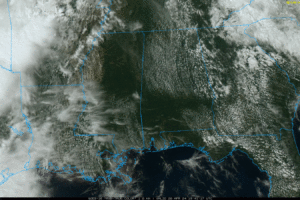
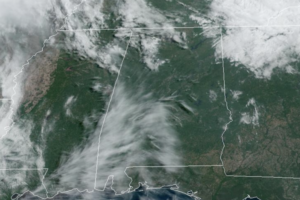
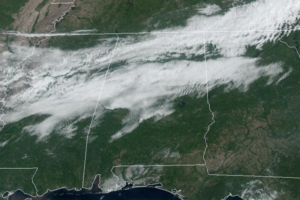
A fairly strong easterly flow is transporting Atlantic moisture into Central Alabama on this Saturday. Skies have become mostly cloudy across most of the area. The best remaining sunshine was over western and eastern sections.
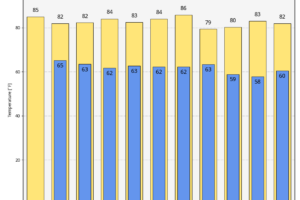
Temperatures are in the 70s, being held back by the cloud cover. The median temperature today will be around 78-79, with a few sunnier locations making it into the lower 80s.
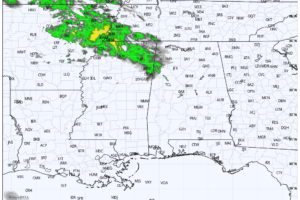
Radars are clear at the noon hour. The closest rain to Birmingham is showers and storms associated with an upper low off the coast of the Carolinas. This upper low is expected to retrograde, or move westward over the next couple of days.
We could see a little drizzle and a few isolated showers on Sunday and Monday as the easterly flow strengthens a bit more. Skies will remain mostly cloudy through the period. Highs will be in the upper 70s unless a little sunshine breaks out and pushes readings to just past 80.
No major rain chances in the next seven days for Central Alabama. The big storm system out west will split over the next few days. A weakened part will lift out to the north, dragging a weak front our way by Wednesday. Rainfall chances will be small and amounts light, but showers could be scattered around through the latter half of the week.
Hurricane Norbert will make landfall on the Baja California Peninsula early this afternoon.
Norbert re-intensified into a major hurricane last night, but fortunately weakened slightly early this morning.
It has top winds around 110 mph, making it a category two hurricane.
It will pass over the Gulf of California and make its second landfall near Ciudad Obregon around 7 p.m. tonight.
The storm will weaken rapidly over the mountainous terrain of Mexico but will continue contributing lots of moisture to the storm system over the western U.S. as it moves on the Plains.
It could help to produce very heavy rains like 1983’s Tico. Shawnee, Oklahoma picked up over ten inches of rain from that system.